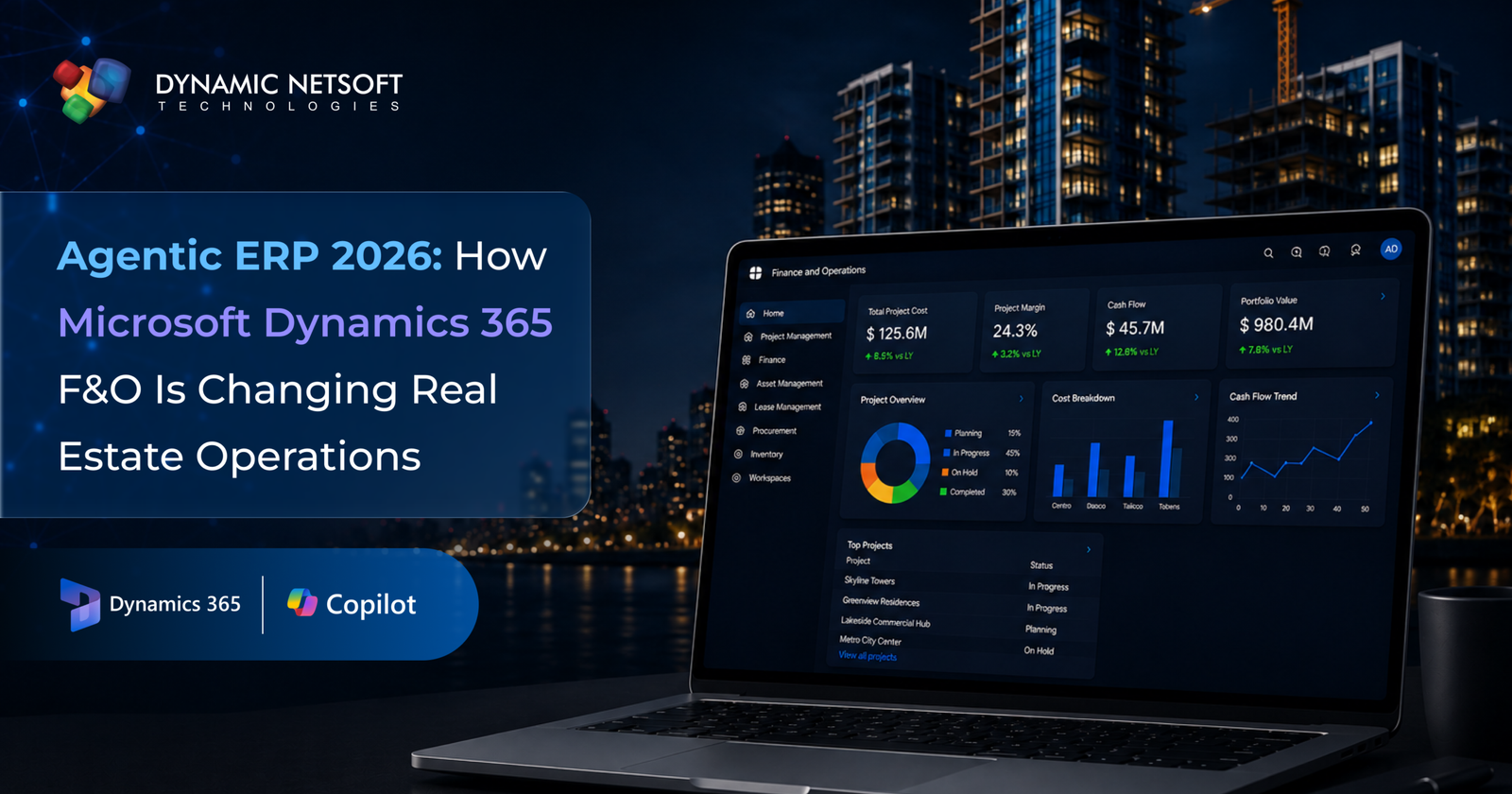
Did you know 23% of firms are now scaling agentic AI systems, while 39% are actively experimenting with AI agents across business functions?
This illustrates that industry is evolving from traditional ERP systems to agentic ERP, where AI is not only used to store or report data but also to help operations.
The largest difficulty for many real estate organizations is disconnected operations. Leasing teams are in one system, finance teams are in another, and project updates, approvals, and vendor communication often take place through spreadsheets and long email chains.
A simple lease change might not be reflected properly in the invoice. Finance teams can get construction updates days later. As operations increase, these gaps result in delays, mistakes, a lack of visibility, and delayed decision-making.
Microsoft Dynamics 365 Finance & Operations, together with Dynamics 365 Copilot, Power Platform, and Azure AI, is tackling this challenge by linking workflows across leasing, finance, construction, procurement, and property management.
The technology can automate approvals, highlight dangers earlier, cut down on manual coordination, and give teams a sharper view of operations in real-time.
What Is Agentic ERP in Dynamics 365?
Agentic ERP in Dynamics 365 is the next evolution of ERP from a passive record-keeping system to an active platform that supports day-to-day activities. Instead of teams manually reviewing reports, tracking approvals, or identifying problems across departments, AI agents may monitor workflows, identify problems, recommend next steps, and automate regular operations.
Real estate organizations may leverage Power Automate, Dynamics 365 Copilot, predictive analytics, and operational data in real time to spot risks around rent collection, project delays, budget overruns, or vendor bottlenecks earlier and respond before tiny concerns become larger operational difficulties.
Why Traditional ERP Is Failing in Real Estate
Modern real estate operations are interwoven workflows across leasing, finance, construction, asset management, and tenant services. But traditional ERP systems were created mostly for accounting, not for day-to-day operational collaboration.
Inflexible Data Silos
Leasing, finance, and field teams sometimes work on distinct platforms, which can result in fragmented data, duplicate entries, and manual updates.
Complex Portfolios Hard to Manage
Properties are different if they are commercial, residential, or mixed-use, but older ERP systems fail to accommodate these differences without customization.
Poor Support for Operational Workflow
Many old-school ERP packages are finance-centric and don’t address operations like tenant billing, maintenance, vendor coordination, and construction monitoring.
Proptech Integration Limited
Legacy systems usually do not connect well with tenant portals, IoT devices, and smart building technology.
Slow implementations and more risk
ERP implementations can take months and typically bring delays, poor visibility, and acceptance issues across real estate operations.
How Dynamics 365 F&O Is Transforming Real Estate Businesses
Consolidated Financial and Lease Management
Microsoft Dynamics 365 F&O lets real estate companies handle lease accounting, invoicing, collections, and financial reporting on one platform. Teams receive centralized visibility across properties, subsidiaries, and investment portfolios instead of working across disconnected platforms.
The software can automate monthly rent invoicing, track tenant arrears, anticipate cash flow, detect billing discrepancies, and automate lease renewals or rent escalation activities. This allows organizations to identify financial concerns earlier and improve operational control.
AI-Driven Construction and Project Visibility
Construction projects often experience fragmented coordination between procurement, contractors, finance, and operations. Dynamics 365 F&O enables teams to monitor project budgets, contractor costs, procurement timescales, and milestone completion in real time.
Its AI-powered skills can spot cost overruns, delayed approvals, or procurement problems before they hit projects. For example, if the material cost is above the anticipated budget, the platform can immediately send alerts to the project and finance teams.
Achieve Real-Time Operational Intelligence with Copilot
With Dynamics 365 Copilot, teams can use natural language prompts to interact with their ERP data rather than creating reports manually or drilling through dashboards.
Users can ask questions such as:
- Show properties with occupancy < 80%.
- Projected income from leasing during the next 12 months.
- Find projects that are delayed on vendor approvals.
This lowers manual reporting and enhances operational decision-making across lease, finance, and construction. Also, you can take a look at the Microsoft Copilot integration with Dynamics 365 modules to build more integrated processes across departments.
How AI Works in Dynamics 365 F&O
The combination of operational data and AI-driven decision assistance is one of the biggest reasons Dynamics 365 F&O is becoming one of the most popular ERP platforms for real estate enterprises in 2026. The technology does not just store transactions; it continuously evaluates operations and helps teams respond faster.
Data Gathering
Data from lease, financing, procurement, construction, maintenance, and customer operations flows into a single integrated system to provide a centralized operating picture.
AI Analysis
Dynamics 365 Copilot and AI models may detect operational signals such as payment delays, cost overruns, approval bottlenecks, forecast abnormalities, and tenant hazards. This data is compared against previous patterns and business standards to discover problems early.
Automation Workflows
The platform may automatically trigger approvals, alerts, escalations, reminder emails, or recommended actions using Power Automate and built-in workflows. AI, for example, can write reminders for missed payment or indicate procurement delays before they damage projects.
Ongoing Learning
As more operational data is fed into the system, AI models become better at forecasting, risk identification, and workflow recommendations over time. Organizations also can choose whether AI should merely advise actions or directly automate work under the supervision of humans.
Why Real Estate Firms are Moving to Agentic ERP in 2026
Real estate companies are encountering greater operational complexity than they ever have. Leasing, finance, construction, maintenance, and tenant management all flow via multiple teams and systems, sometimes causing delays and poor visibility.
Traditional ERP systems are failing to keep up as they mostly capture data and don’t enable teams to act on it. Today, companies want systems to automate routine work, reduce manual coordination, flag risks early, and improve decision-making across operations.
This is why agentic ERP is getting popular in 2026. AI-powered ERP systems can track workflows, spot concerns, send out approvals, and automate tasks across departments, rather than simply creating reports. McKinsey forecasts that agentic AI may create between $430 billion and $550 billion in value for the real estate industry.
Conclusion
With AI being adopted more broadly throughout enterprise operations, Dynamics 365 F&O is moving beyond a traditional ERP solution. It helps real estate and construction firms integrate data, automate workflows, and make faster operational choices across leasing, financing, and project management.”This level of visibility and automation is a significant advantage to organizations that manage complicated portfolios and construction activities. Dynamic Netsoft helps real estate companies adopt Dynamics 365 for construction to solve unique difficulties, enabling you to establish more connected, scalable, and future-ready operations.