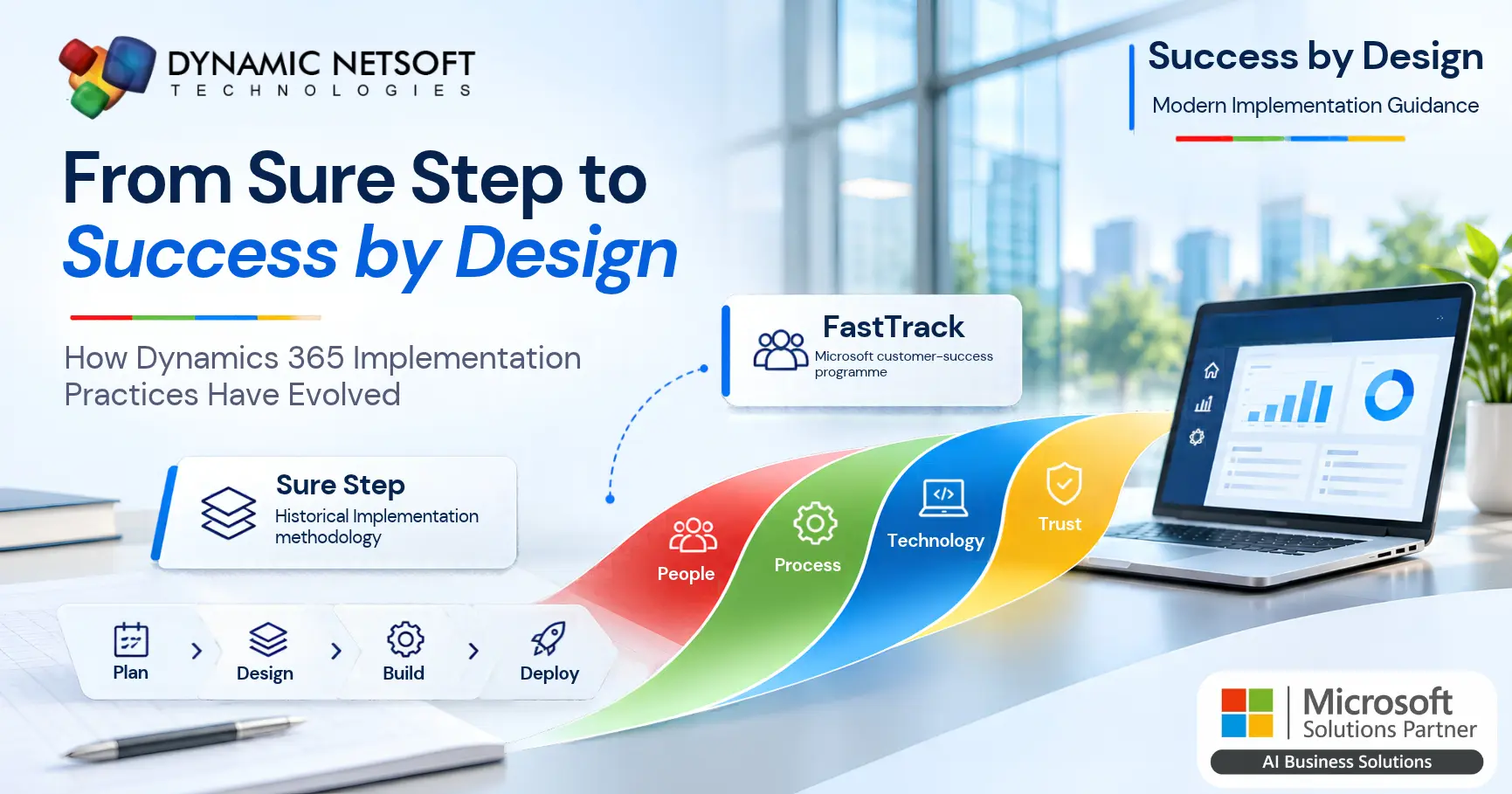
For years, Microsoft Dynamics implementation partners relied on Sure Step to structure ERP projects, manage delivery activities and guide customers through implementation. As Microsoft’s business applications evolved towards cloud-based services, however, the challenges of delivering a successful implementation changed.
Microsoft introduced FastTrack for Dynamics 365 to provide customers and implementation partners with access to expert guidance from its product engineering teams. The experience gained through thousands of customer deployments eventually shaped Success by Design, a framework focused on identifying implementation risks and improving solution quality.
But what does this change mean for organisations already using Sure Step? Does Success by Design replace the earlier methodology, and should existing Dynamics 365 projects follow a different approach?
Why Did Microsoft Move Beyond Sure Step?
Microsoft Dynamics Sure Step provided a structured implementation methodology covering six phases: Diagnostic, Analysis, Design, Development, Deployment and Operation.
It helped implementation teams organise project activities, define responsibilities, document requirements and manage delivery. It also supported different Dynamics products and implementation approaches.
However, the Dynamics ecosystem changed considerably with the introduction of cloud-based Dynamics 365 applications.
Organisations increasingly needed to manage complex integrations, cloud environments, customisations, data migration, security requirements and continuous application updates. Completing the planned implementation activities was no longer enough to establish whether the resulting solution was scalable, maintainable and aligned with Microsoft’s product direction.
This created a need for more proactive technical guidance and structured reviews throughout the implementation lifecycle.
Rather than simply changing its existing methodology, Microsoft developed a broader approach to evaluating implementation quality and identifying risks earlier.
What Is Microsoft FastTrack for Dynamics 365?
FastTrack is Microsoft’s customer-success programme designed to help eligible organisations implement Dynamics 365, prepare for go-live and realise value from their business applications.
It brings together Microsoft solution architects, implementation partners and customer teams to provide guidance during important stages of a project.
Through FastTrack, customers can receive:
- Solution architecture and implementation guidance.
- Expert-led workshops and technical recommendations.
- Solution Blueprint Reviews.
- Implementation reviews and risk assessments.
- Go-live readiness guidance.
An important distinction is that FastTrack solution architects do not take over the implementation partner’s responsibilities. They do not design or develop the customer’s solution. Instead, they provide expert recommendations and assess whether the implementation follows Microsoft’s recommended practices.
The experience gained through these customer engagements became the foundation for a more consistent implementation framework.
How Did Success by Design Emerge from FastTrack?
As Microsoft’s FastTrack team worked with customers across complex Dynamics 365 deployments, it encountered recurring implementation challenges.
Individual solution architects brought valuable experience to projects, but Microsoft needed a consistent way to share that knowledge and identify potential problems before they affected project outcomes.
The company developed structured reviews and workshops to examine important implementation decisions at different stages. These reviews helped teams identify architectural gaps, technical risks and deviations from recommended practices while there was still time to address them.
Success by Design emerged from this experience.
It brings Microsoft’s implementation knowledge into a repeatable framework that customers and partners can use throughout a Dynamics 365 project.
The framework follows five stages in Microsoft’s current implementation guidance:
- Strategize: Establish business objectives, project scope and the overall implementation strategy.
- Initiate: Define project workstreams, governance, responsibilities and solution architecture.
- Implement: Configure, develop, integrate and test the agreed solution.
- Prepare: Complete user acceptance testing, training, cutover planning and go-live readiness activities.
- Operate: Stabilise the live solution, manage updates and continuously improve business operations.
A key part of this approach is the Solution Blueprint Review, which examines areas such as application architecture, data, integrations, testing, security, business processes and environment strategy.
Sure Step vs. FastTrack vs. Success by Design: What Is the Difference?
These three concepts serve different purposes within the Dynamics implementation ecosystem.
| Area | Sure Step | FastTrack | Success by Design |
|---|---|---|---|
| Nature | Implementation methodology | Microsoft customer-success programme | Implementation guidance framework |
| Primary focus | Project delivery and activities | Expert guidance and customer success | Solution quality and risk management |
| Main contribution | Phases, tasks and deliverables | Workshops and technical expertise | Reviews and recommended practices |
| Participants | Implementation teams | Microsoft, partners and customers | Customers and implementation partners |
| Application | Historical Dynamics methodology | Eligible Dynamics 365 deployments | Across Dynamics 365 implementation projects |
The important distinction is that Success by Design is not a direct replacement for an organisation’s chosen implementation methodology.
Microsoft recommends using Success by Design alongside an appropriate delivery approach, whether Agile, Waterfall or a hybrid methodology.
An implementation partner can continue using its established project management processes while incorporating Microsoft’s recommendations and reviews.
Does This Mean Existing Sure Step Projects Are a Waste?
No. An existing project does not become unsuccessful simply because it was implemented using Sure Step.
The methodology used to manage an ERP project does not independently determine the quality of its final solution.
For example, an organisation that previously implemented Dynamics AX using Sure Step may already have valuable business process documentation, functional designs, data migration procedures, testing records and operational knowledge.
Those investments do not lose their value because Microsoft introduced Success by Design.
What matters is whether the current solution continues to meet business requirements and aligns with the technical direction of Dynamics 365.
Existing customers should assess their solution architecture, integrations, customisations, security, performance and readiness for ongoing platform updates.
Success by Design can also be introduced during an implementation that is already underway. Teams can review existing decisions, identify outstanding risks and incorporate relevant guidance into the remaining project activities.
There is no general requirement to restart an existing implementation simply because it previously followed Sure Step.
Does Every Dynamics 365 Customer Get FastTrack?
Not necessarily.
Microsoft has specific eligibility requirements for FastTrack services, including licensing expenditure and qualified implementation partner criteria.
Customers who do not qualify for a full FastTrack engagement can still access Microsoft’s self-service resources, including Success by Design training, implementation guidance and product TechTalks.
For Dynamics 365 Finance and Operations implementations, there is another important requirement: projects must complete Microsoft’s Go-live Readiness Review before deploying their production environment.
This review examines project information and provides potential risks, best practices and recommendations to support a successful deployment.
It is an important quality checkpoint, but it does not guarantee that an implementation will achieve every expected business outcome.
How Can Dynamic Netsoft Help with a Dynamics 365 Implementation?
As Dynamics 365 implementation practices evolve, organisations need partners who understand both their business processes and the technical decisions involved in building an ERP solution.
At Dynamic Netsoft, our Dynamics 365 implementation approach focuses on understanding business requirements, designing appropriate solutions and supporting customers throughout their implementation journey.
This includes evaluating standard functionality, planning data migration, assessing integrations and customisations, validating testing strategies and preparing for deployment.
By incorporating relevant Success by Design principles, implementation teams can identify potential risks earlier and make informed decisions about solution architecture, scalability and long-term maintainability.
The objective is not simply to complete an ERP deployment. It is to establish a reliable Dynamics 365 environment that supports business operations as organisational requirements evolve.
Conclusion
The evolution from Sure Step to Success by Design reflects how Microsoft’s approach to Dynamics implementation has developed alongside its cloud business applications.
FastTrack provided Microsoft with experience across thousands of customer deployments, and Success by Design transformed those lessons into structured implementation guidance.
For existing customers, this change does not invalidate previous ERP investments. For organisations planning new implementations, it offers a more proactive way to examine solution quality and manage implementation risks.
Ultimately, successful Dynamics 365 implementation depends on more than following project phases. It requires sound architecture, informed decisions, effective testing and a solution that continues to support the business after go-live.