
Dynamics 365 implementation is a big move for your business. Getting it right matters. So, before you dive in, there’s one decision that can shape the entire outcome: how will you approach the implementation?
Chances are, you’ve already heard the buzz around these two: Waterfall and Agile. Both come with their own pros, cons, and loyal fan bases.
So, which one works better when dealing with something as complex and customizable as Dynamics 365?
In this blog, we’ll explain what a project methodology is, why it matters, the differences between Waterfall and Agile, their pros and cons, and help you figure out which one works better for your business.
Let’s dive in.
Why is it Important to follow a Methodology for Dynamics 365 ERP Implementation?
A methodology is the plan your team follows to get the implementation done. It describes how you organize tasks, make decisions, handle changes, and deliver results.
When it comes to Dynamics 365 ERP implementation projects, having the right methodology is critical. It shows you where you’re headed, how to get there, and what to look out for along the way. Choosing the wrong one can easily become one of the key reasons for your Dynamics 365 implementation failure.
When you’re implementing something as complex as Dynamics 365, having a clear methodology is like having a GPS. It keeps the team focused and heading in the right direction.
A good methodology will;
- Break the project into clear stages with specific goals
- Map the route
- Assign the right people to the right jobs
- Follow best practices to reduce risk and increase quality
- Save time and budget by working smarter
Dynamics 365 Implementation Methods: Waterfall Vs Agile – What’s the Difference?
If you’ve chosen to start a Dynamics 365 implementation, that’s a smart first step. But before you get started, you need to select the appropriate project approach. This will determine how your team plans, builds, and delivers the entire system.
There are two most common approaches: Waterfall and Agile.
Waterfall – The Structured Approach
Think of Waterfall as your step-by-step manual. You finish one step completely before moving on to the next. It’s structured and predictable. It works well when you know your needs in and out. You start by gathering all the project requirements. Then you move through each phase in the following order;
Analysis → Design → Development → Stabilization → Deployment
- Analysis: The team gathers all the requirements from you to understand exactly what the system should do. No development starts until everything is documented and approved.
- Design: The team creates detailed plans for how the system will function, including screen layouts, workflows, and data models. With this step, everyone gets a clear idea of what the final system will look like and how it should work.
- Development: Developers write the code based on the approved design. Each feature is built according to the specifications laid out in the previous phase.
- Stabilization: The system is tested to find and fix bugs, performance issues, or anything that doesn’t work as expected.
- Deployment: The final system is moved to the live environment and made available to users.
Agile – The Flexible Method
Agile is a flexible working method that allows you to adjust to changes and feedback. Instead of planning everything before, Agile lets you learn and adjust as the project moves forward. In Dynamics 365 implementation projects, many features come built-in. Any extra features or changes are written down in a list called a backlog. From there, teams pick user stories for each sprint, work on them in short cycles, and deliver a tested, working piece of software by the end of each sprint.
After each sprint, users give feedback, which helps improve the next one. This cycle continues until the backlog is cleared or the solution is ready. Agile encourages close teamwork between users and developers to make sure the final product meets real needs.
Hybrid Approach: The Best of Both
Not sure which one to pick? That’s where the Hybrid approach helps. It mixes Waterfall’s step-by-step planning with Agile’s flexible way of working, making it a good fit for projects like Dynamics 365, where both structure and adaptability are important. During initiation, modeling, testing, and deployment, it follows a fixed, step-by-step process. These phases don’t loop back once completed.
In the middle, it uses an iterative approach during the build phase. Requirements, design, development, and testing are done in short cycles, with regular updates and improvements. This setup gives early visibility into the solution and allows teams to make changes before it’s too late. It balances structure with flexibility.
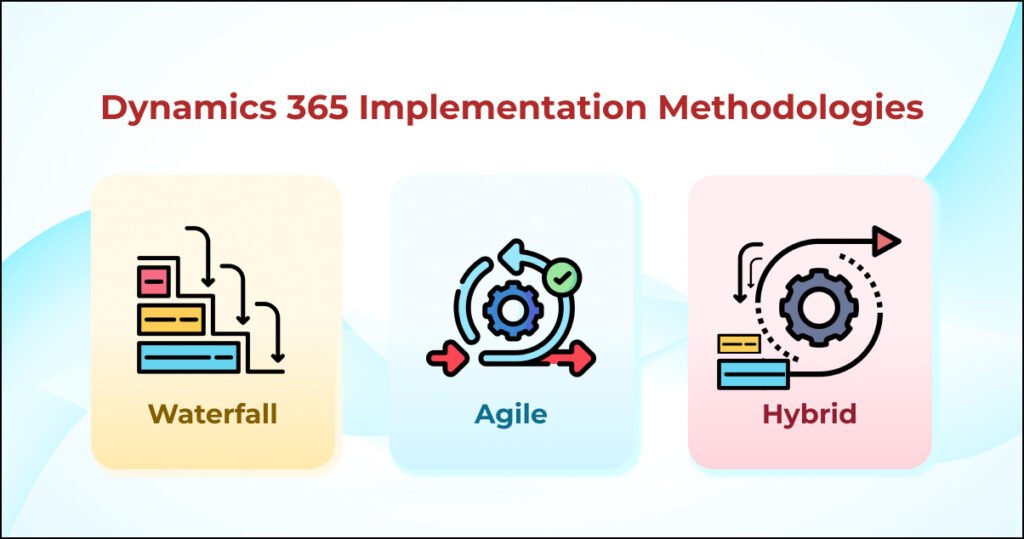
Weighing the Pros and Cons of the Different Dynamics 365 Implementation Methodologies: Waterfall Vs Agile Vs Hybrid
Alright, now that we’ve met the contenders, it’s time to pit them against each other. Let’s break down what each approach brings and what you might want to watch out for.
Waterfall Model
| ProsPros | Cons |
| Straightforward and easy to follow with a clearly defined structure | Risk of wasted effort if assumptions made early on prove incorrect |
| Easy to control and track | Inflexible to change |
| Strong documentation ensures alignment and traceability | User feedback often comes too late to make meaningful changes |
| Predictable timeline and budget | It’s disconnected and limits communication |
Agile Model
| Pros | Cons |
| Adapts quickly to changing needs and user feedback | Maintaining consistency and quality across many sprints can be difficult |
| Encourages constant collaboration between users, stakeholders, and developers | Needs strong involvement and availability from users and decision-makers |
| Puts user needs at the center of every sprint, ensuring value-driven delivery | Integrating Agile with larger, cross-functional teams or systems can be complex |
| Delivers working software in shorter cycles, reducing risk and rework | Since things evolve, it’s tough to pin down final budgets or deadlines |
Hybrid Model
| Pros | Cons |
| You get Waterfall’s solid planning and Agile’s adaptability | Requires experienced teams to manage both structured and flexible phases |
| Balances upfront planning with iterative development and feedback loops | Quality control across mixed workflows needs special attention |
| Offers early visibility into the solution with the scope of correction | Coordination between sequential and iterative elements can get complicated |
| Suits most Dynamics 365 projects by adjusting to different scopes and team setups | Stakeholder alignment may take extra effort due to the mixed approach |
Choosing the Right Methodology for Your Dynamics 365 ERP Implementation
Choosing between Waterfall, Agile, or Hybrid implementation models depends on several key factors, such as;
Assessing Project Complexity and Requirements
If your project has fixed, well-defined requirements that are unlikely to change, Waterfall is a good fit. Agile or Hybrid methods allow for more flexibility and adjustments for projects where requirements may evolve.
Organization’s Culture and Readiness
Agile works best in teams that are open to change and like to collaborate often. If your organization prefers structure or isn’t used to fast changes, Waterfall or Hybrid might be easier to manage.
Resource Availability
Agile needs skilled team members who can work in short cycles and stay engaged. If such resources are limited or stakeholder involvement is inconsistent, Waterfall or Hybrid may be more practical.
Risk Management Considerations
Each method comes with its own risks. Waterfall may not catch problems early, while Agile can be hard to control if the scope keeps changing. Hybrid helps balance both by offering structure with room for changes.
Choosing the right project methodology for your Dynamics 365 ERP implementation isn’t just about following the trends. The approach should align with your project goals, team dynamics, and business priorities.
To make the best decision, contact a trusted Microsoft Dynamics 365 partner, particularly one with experience in your industry. A quality partner will provide technical advice and take the time to understand your business goals, current challenges, team structure, and long-term vision. With that insight, they can assist you in selecting the most effective project methodology to deliver the best Dynamics 365 implementation services, supporting your timeline, budget, and growth strategy.
Whether you choose the predictability of Waterfall, the flexibility of Agile, or the balanced framework of Hybrid, the key is to remain focused on delivering value with each phase. Reach out to a certified Dynamics 365 partner today to initiate your Dynamics 365 implementation with clarity and the right strategy.